
Malini (1947 - 2025)
A tribute to one of Sri Lanka's greatest actors, the "Queen of Sri Lankan Cinema", whom I had the privilege of meeting for half an hour in 2014.

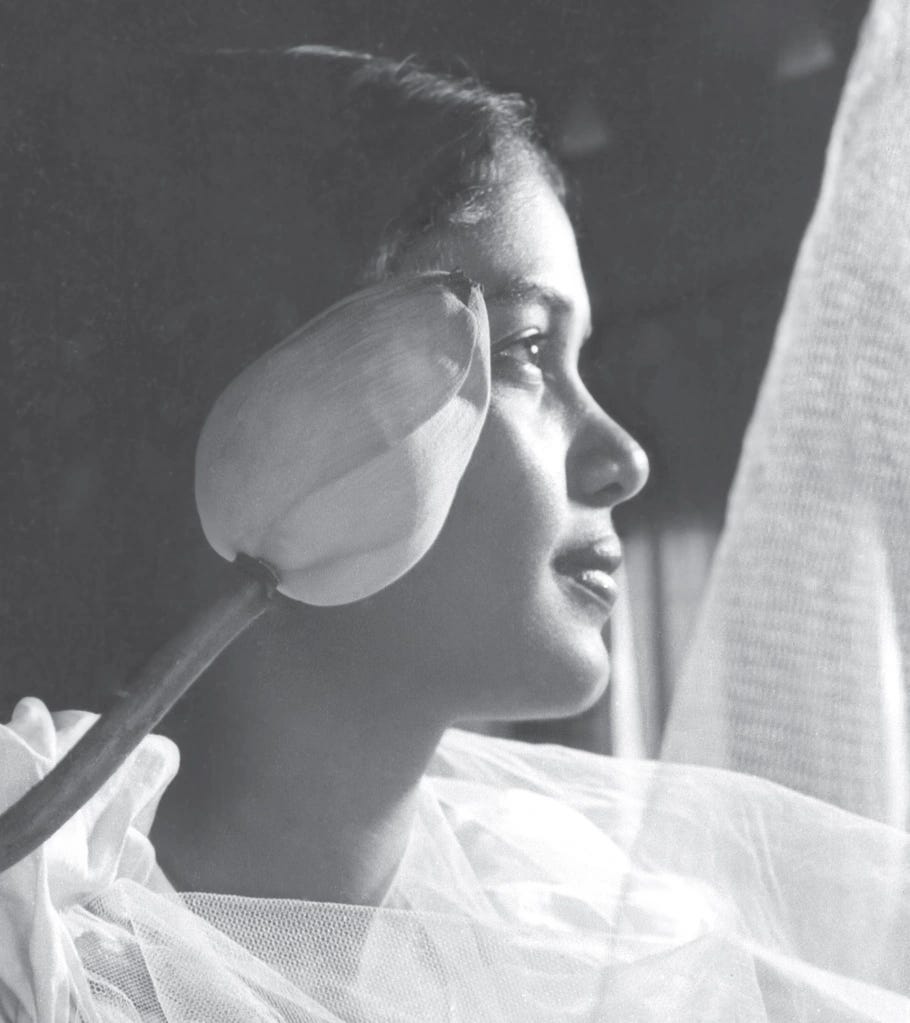
I met Malini Fonseka only once, at her residence near Thalawathugoda, and that for a very short time – probably no more than 30 minutes – in 2014. She was an MP back then, and seemed quite tired. But she was willing to talk. She had nothing much to add to what countless journalists had written of her. Out of respect for her health, I quickly wrapped up the interview and made my way home.
It was only when I was back that I realised how feeble my questions had been. There was, as I listened to the recording, nothing substantively new about her that I had been able to get out. What drove her career? What explained her phenomenal success and popularity? Why did countless actors, across so many generations, look up to her? And what made her performances tick?
Perhaps I was wrong in assuming that actors like Malini would know the answers to these questions. It was like Peter Bogdanovich interviewing John Ford: no matter how hard the young cineaste tried, the old master would give only the most obvious answers. “You made a picture called Three Bad Men,” Bogdanovich began, “and you had quite an elaborate land rush in it. How did you shoot that?”
Pat came Ford’s reply: “With a camera.”
Malini embodied a sensibility, a way of performing, a way of looking at the world, that I suppose was not too different to John Ford’s conception of directing. Reflecting on K. A. W. Perera, I noted that he belonged to a league of artistes who were innocent of artistic pretensions: they felt they had to do something, tell a story and entertain a crowd, and they made films to achieve those primeval ends.
I am not sure to what extent this applies to Malini’s acting. But I am aware that her characters made us want her and made us go to any lengths to have her. And she did it without much effort.
She didn’t want anyone dominating her, but she got every man wishing they could dominate her. I find it difficult to think of another actress who could equal her there. Probably that’s why she was never cast as a femme fatale; the closest she ever got to such a figure was the heroine in Sasara Chethana, a film she herself directed.
In her commercial outings, she was rarely prone to outbursts. Almost never, for instance, did she hit at a male co-star from a position of authority. One of the few exceptions here was Sahanaya, where she acted alongside Gamini Fonseka and where, in one sequence, she struck at Gamini when the latter – playing a poor but talented artist – dared to paint her without her knowing at a golf course.
It's moments like these when you realise that, even in commercial films, she was capable of breaking out of character and inverting her roles when she felt she had to. In her first few performances, however, she was too reticent to do that. Only the immense popularity she won could have convinced her to change.
Malini Senehelatha Fonseka was born to a lower middle-class family in 1947 in Peliyagoda. She was the third child in a family of 11. Initially educated in Nugegoda, she shifted to Gurukula Maha Vidyalaya, Kelaniya, where she befriended some future collaborators: Wimal Kumar da Costa, H. D. Premaratne, and Donald Karunaratne.
Gurukula bordered on the Vidyalankara Campus, now the University of Kelaniya. One day some students from Vidyalankara came over, looking for an actress to play a lead role. The problem was that the university had no women.
The dancing teacher at Gurukula considered Malini. Having asked her, he cast her once she got permission from her parents. The play, Noratha Ratha, directed by H. D. Werasiri, marked the first time she had acted outside school.
In 1965 she took part in Akal Wessa, a play written by Sumana Aloka Bandara that won for her a Best Actress Award. It also won the attention of two members in the audience who were looking for a newcomer to play the leading role in an upcoming film.
Tissa Liyanasuriya and Joe Abeywickrama selected her for their film that evening. Remembering his decision decades later, Tissa told me, “Some people thought she was too thin, too untried. Joe on the other hand was satisfied with her, as was I. So we took her in. It was a choice we never came to regret.”
The film in question, Punchi Baba, marked Malini’s entry into the cinema. When we talked about her acting in it, Liyanasuriya recalled, “I didn’t order her about. She seemed fully involved.”
That sense of being involved was what defined her career in the 1970s. But in her first few performances – including her second, as the sister to a romantically obsessed lover, played by Henry Jayasena, in Dahasak Sithuvili – she was more the girl who lived next door than the girl who could win your heart. We were almost inclined to forget her: she existed as a sort of feminine foil to the male characters.
Malini quickly outgrew that phase. You see her shedding her reticence in Akkara Paha (1969), where she plays the sister to another obsessed brother played by Milton Jayawardena. In Dahasak Sithuvili she succumbs to Henry Jayasena’s moods; here she’s more contained, more assertive. The girl from Punchi Baba was evolving, discovering herself, and letting herself be known. By the time of her performance in Nidhanaya, she has become aware of her potential: she has let go of being the girl next door.
She underwent a process of self-discovery throughout the 1970s. Dharmasena Pathiraja played a pivotal part in this transformation: from a minor role in Ahas Gawwa to the heroine in Eya Dan Loku Lamayek, to more assertive parts in Bambaru Avith and that understated masterpiece, Soldadu Unnahe – the latter of which has her as a particularly acerbic but convincing prostitute.
I remember asking Malini what her favourite film was. Perhaps it was the wrong time to ask, or the wrong question. Either way, she replied, “Aradhana.”
As the conversation wore on, it became clear to me that Malini had a soft spot for the 1980s – Aradhana came out in 1981. She admitted to me that these were her favourite years, in which she rose from a performer to director: Sasara Chethana in 1984, Ahinsa in 1987, Sthree in 1991, Sandamala in 1994.
These productions all revolve around femininity and motherhood, not unusual for a woman like her. “I firmly believe in a feminism that is fundamentally based on motherhood,” an actress told Malinda Seneviratne. This was the femininity that Malini embodied, and exuded, in the films she directed.
As the years went by, Malini took on progressively matriarchal roles, as shown in Punchi Suranganawi (2002), Wekanda Walauwwa (2003), and Ammawarune (2006). Prasanna Vithanage’s Akasa Kusum (2009) came as a breath of fresh air, given how it symbolised the end of a career. Without dispute, it marked her best performance since Bambaru Avith, because it was so reflective – as the photographs of her in her younger days featured in the film make it obvious.
In his tribute to Malini, the critic Gamini Akmeemana commented that “there has never been any replacement, and there’s no one within sight.”
I am inclined to agree. Malini had many predecessors, and I suppose she had many successors – as all actors worth their salt have had. But there was quite no one like her. No one, not even the most egregious makeup artist, could conceal her natural beauty. That beauty came not in spurts but in gushes. In most of her roles, she exuded a sense of empathy that helped us square her with that beauty.
And now, she’s gone. Just like that.